


Rethinking Societal Securities: “The Helsinki Approach”
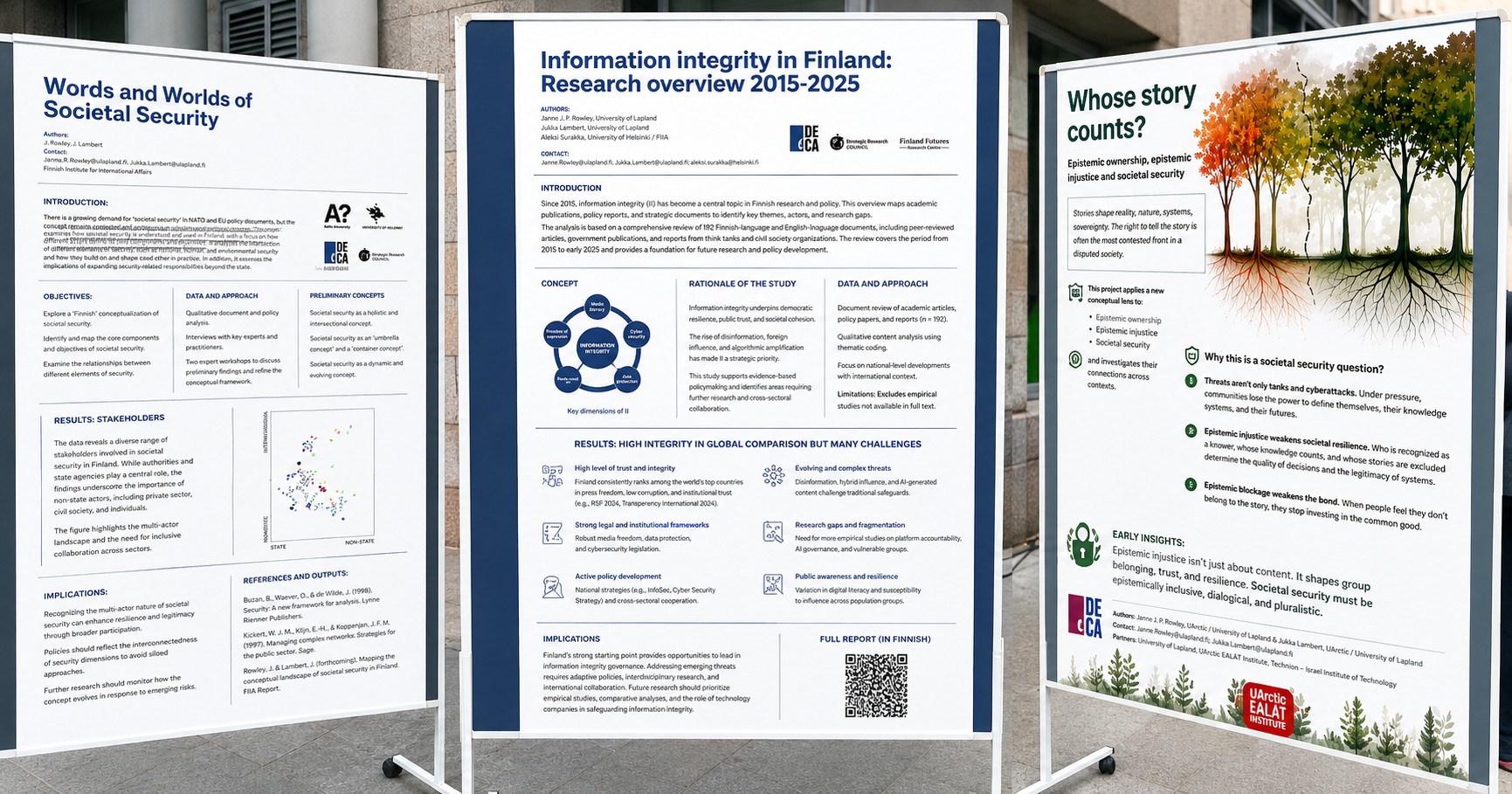
The Faculty of Social Sciences at the University of Helsinki is leading the establishment of the Societal Security Hub to advance the university’s research, teaching, and societal impact in the field of societal security. As part of this initiative, academics from the University of Helsinki met at the Societal Security Research Day, 20 May 2026, to discuss various dimensions of societal security. Those dimensions were central to reflections by Professor Leena Malkki and Professor Risto Kunelius (DECA’s co-lead) on societal security, public trust, and the future role of universities.
Their observations point toward a broader challenge: if security becomes an all-encompassing framework, how do we preserve democracy, privacy, and critical debate while still responding to real vulnerabilities?
Beyond state security
Traditional understandings of security have largely focused on the state: national sovereignty, territorial integrity, and protection against external threats. Societal security shifts the focus elsewhere — toward the collective life of society itself. This shift is especially visible in Nordic approaches to comprehensive security, where resilience depends not only on military preparedness but also on the functioning of institutions, infrastructure, public trust, and civic participation.
Yet, as Malkki noted, the Finnish discussion itself reveals tensions embedded in the language: English often separates “security” and “safety,” a distinction that does not exist in Finnish. Finland's recent official approach has combined the two into kokonaisturvallisuus, comprehensive security.
The concept of societal security, the focus of the new hub, has developed through at least two distinct Nordic intellectual traditions. One sees society primarily as a shared identity. Associated with securitization theory and the Copenhagen School, this perspective asks whose identity, values, or collective existence is being protected. Security here is deeply political because threats are socially defined and contested. The second tradition approaches society through its life-sustaining functions: governance, services, infrastructure, communication, and social cohesion. This version is closer to policymaking and practical preparedness, forming much of the basis for Nordic comprehensive security models. These two traditions are often treated separately. But, Malkki argued, perhaps they should not be.
What makes a society sustainable?
Rather than framing societal security solely in terms of risks and threats, Malkki suggested a broader orientation: what makes a society sustainable in the first place?
That question changes the emphasis. Instead of focusing on crisis management or resilience after disruption, societal security becomes about protecting the conditions that allow collective life to function over time: trust, participation, dignity, institutional legitimacy, and social continuity.
This also means acknowledging that society is shaped by everyone — but not evenly. Security policies and infrastructures distribute protection unevenly, often producing unintended consequences. Decisions made in the name of security may strengthen some groups while marginalizing others. That tension matters because societal security increasingly touches domains once considered outside the security sphere altogether.
When security becomes “about everything”
Kunelius expressed uneasiness about the expansion of security discourse into nearly every area of public life. The danger is not merely conceptual inflation. When crises and exceptions become permanent features of governance, democratic debate itself can narrow. Security logics often justify secrecy, urgency, and exceptional measures. Yet democratic societies depend on open disagreement and public deliberation.
Ensuring democratic debate becomes a central societal security question in its own right. This challenge becomes urgent in a digital environment shaped by datafication and AI. As security institutions gain access to ever more data and analytical capabilities, traditional boundaries between sectors begin to blur. Universities, governments, technology companies, and security actors increasingly operate in overlapping ecosystems.
Kunelius raised a critical institutional question: what should be the proper distance between academic institutions and security structures? The issue is not whether universities should contribute expertise — they already do. The issue is whether academic independence can survive if security imperatives begin to dominate knowledge production itself.
The role of universities
Universities occupy a particularly complex position. On one hand, they are increasingly expected to contribute to preparedness, resilience, and technological innovation. On the other hand, their legitimacy depends on maintaining spaces for critical distance, independent inquiry, and intellectual openness. Kunelius emphasized that universities should remain friendly places: not in the sense of avoiding disagreement, but in the sense of sustaining trust, openness, and human dignity as prerequisites for meaningful knowledge production.
However, those characteristics of universities may become harder as AI systems reshape research practices, institutional incentives, and public communication. Yet the developments also make the traditional work of academia more important, not less. The response to technological transformation cannot simply be faster adaptation. It also requires preserving the intellectual capacities needed for critique, interpretation, and reflection.
Toward a “Helsinki Definition” of Security
The discussions by Malkki, Kunelius, and other esteemed keynote speakers at the Research Day on security point to a major conceptual shift: Security cannot be reduced to protecting the state alone. Nor can it become an unlimited rationale for intervention into every sphere of life. The challenge is finding a conception broad enough to address interconnected vulnerabilities, yet restrained enough to preserve democratic openness and institutional autonomy.
Malkki suggested a multipronged approach: one that combines identity, functionality, sustainability, and democratic legitimacy. Such an approach would ask not only what threatens society, but what enables society to remain livable, trustworthy, and democratic over time. The work towards understanding and developing a renewed concept of societal security, or securities in plural, will be conducted in the new Hub, together with a broad array of stakeholders.
* * *
DECA has contributed to the work of the Hub in various events, including the launch of the Hub with a keynote from DECA’s lead, Professor Mervi Pantti, the Societal Security Forum, co-organized by the Ministry of Interior and the Finnish Innovation Fund Sitra, and an event co-organized by the Nordic Review of International Studies on Finnish security policy.

arrows & pagination